Dental Implants: Does It Actually Matter Which Specialist You Choose?
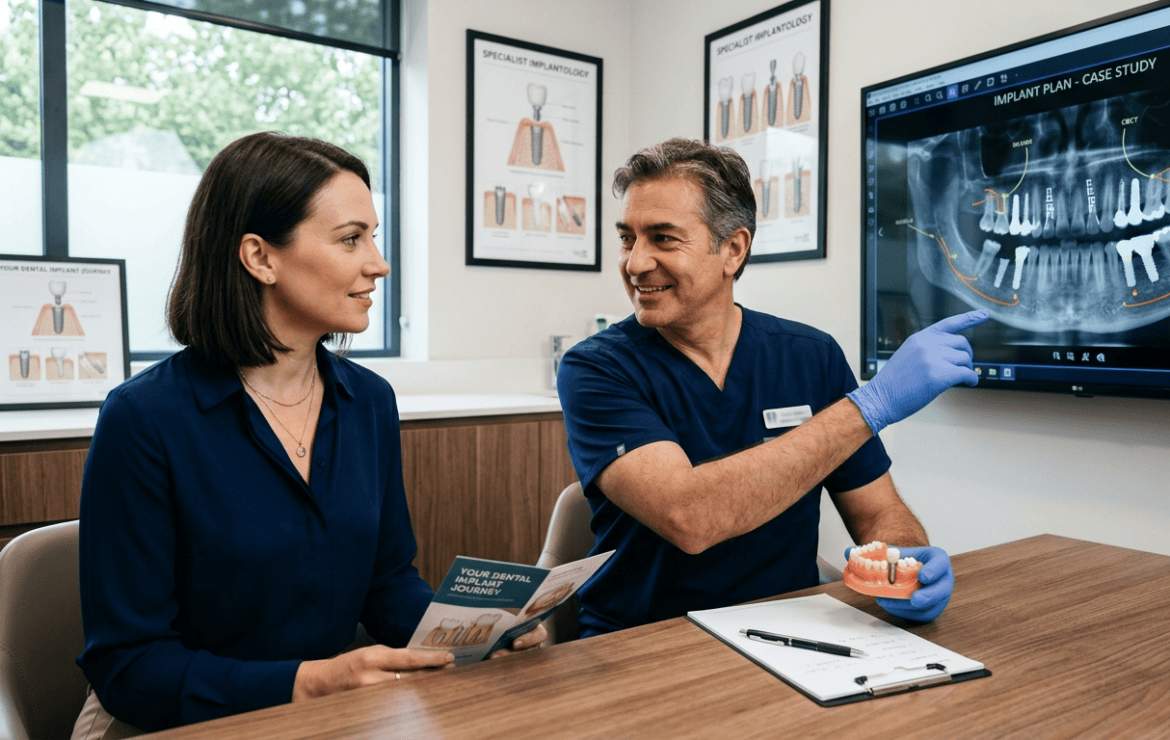
Not all dental providers who offer implants have the same training. Understanding the differences can save you from a costly mistake.
Somewhere along the way, dental implants became one of the most offered — and most misunderstood — procedures in modern dentistry. Walk into almost any dental office today and you’re likely to see them advertised on a poster. The procedure has gone mainstream, and that’s mostly good news for patients. But it has also created a confusing landscape: general dentists, oral surgeons, periodontists, and prosthodontists all offer implants. Are they all equally qualified? The honest answer is no — and the differences matter more than most patients realize.
What a dental implant actually involves
Before comparing specialists, it helps to understand what the procedure entails. A dental implant is a small titanium post inserted into the jawbone where a tooth root used to be. Over several months, the bone fuses around it — a process called osseointegration. Once that’s complete, a custom-made crown is attached on top, creating a replacement that mimics a natural tooth in both function and appearance. The process has two distinct phases: the surgical placement of the post, and the restorative phase, where the visible tooth is designed and fitted. These require very different skill sets. Some specialists are trained primarily for one; only a few are trained thoroughly for both.
The specialists you’ll encounter — and what they actually trained for
When looking into implants, most patients will come across four types of dental professionals. Here’s an honest breakdown of each.
General dentists
General dentists form the backbone of dental care, and many have pursued additional implant training through weekend courses or continuing education programs. Some are genuinely skilled at placing straightforward single-tooth implants. The catch is that this training is highly variable — there’s no standardized requirement for how much a general dentist must learn before offering the procedure. For uncomplicated cases, a well-trained general dentist can be a perfectly reasonable choice. For anything more complex, they’ll often refer you elsewhere.
Oral and maxillofacial surgeons
Oral surgeons are among the most technically skilled practitioners when it comes to the surgical side of implants. Their training — often four to six years of residency combined with medical education — covers bone grafting, extractions, and complex surgical cases. If your implant requires significant jaw reconstruction or you have anatomical complications, an oral surgeon may well be involved. Their limitation is that their focus is the surgery itself. The final restoration, the part that actually shows when you smile, typically falls outside their specialty.
Periodontists
Periodontists specialize in the gums and the supporting structures of teeth. They’re an important part of the picture if you have a history of gum disease, bone loss, or ongoing periodontal issues — all of which can affect implant success. Like oral surgeons, their three-year residency focuses on the biological and surgical environment around teeth rather than on designing and fabricating the final restoration.
Prosthodontists
Prosthodontists are dental specialists whose entire three-year ADA-accredited residency is devoted to one thing: replacing and restoring teeth. Crowns, bridges, dentures, full-mouth reconstruction, and implants — this is all they study. They are the specialists most focused on the final outcome: how the tooth looks, how it fits your bite, how it interacts with surrounding teeth, and how it holds up over time. Crucially, prosthodontists are trained to think in reverse — starting from the desired final result and working backward to determine how and where the implant needs to be placed. This “restorative-driven” planning is something other specialists may not consistently apply.
A side-by-side comparison
The table below summarizes how each specialist’s training aligns with the different demands of implant treatment.
| Specialist | Residency | Surgical training | Restorative training | Full implant process |
| General dentist | None (CE only) | Basic | Yes | Case-dependent |
| Oral surgeon | 4–6 yrs | Expert | Limited | Surgical phase |
| Periodontist | 3 yrs | Expert | Moderate | Surgical phase |
| Prosthodontist | 3 yrs | Yes | Expert | Both phases |
Why the restorative phase is often underestimated
Patients tend to focus on the surgery — and understandably so. It’s the part that sounds most intimidating. But the restorative phase is where implants succeed or quietly fail. A crown placed at the wrong angle can affect your bite. Improper contouring can trap food and lead to infection around the implant. Poor color matching stands out every time you smile. These aren’t catastrophic failures — they’re the subtle, frustrating kind that take years to fully notice and are expensive to correct. Because prosthodontists train specifically in occlusion (how teeth meet), dental materials, and aesthetic outcomes, they tend to catch and prevent these issues before they ever become a problem. The implant may last — but it’s the restoration on top that determines how well it actually performs and how natural it actually looks.
| “The implant may last — but it’s the restoration on top that determines how well it actually performs and how natural it actually looks.” |
When other specialists make sense
This isn’t to say prosthodontists are the only reasonable choice in every scenario. Dentistry often works best as a team. If your case involves significant bone loss, a compromised jaw, or complex extractions prior to implant placement, an oral surgeon or periodontist may be the right person for that surgical phase. Many prosthodontists work alongside oral surgeons specifically because of this — the surgeon handles the structural work, and the prosthodontist designs and delivers the final restoration. For a single, straightforward implant in a patient with good bone density and healthy gums, a skilled and experienced general dentist may be entirely adequate. The key word is experienced — not just trained.
Questions worth asking before you commit
Regardless of which type of specialist you see, these are reasonable questions to raise during a consultation:
- How many implant cases have you completed, and do you have before-and-after photos I can review?
- Will you be handling both the surgical placement and the final restoration, or will another provider be involved?
- How do you plan treatment — do you start from the desired final result, or from what’s surgically easiest?
- What happens if there are complications down the road? Do you manage those in-house?
- What type of crown material do you recommend for my specific situation, and why?
A provider who answers these questions clearly and confidently — without rushing you toward a booking — is usually a good sign. One who struggles or pivots quickly to pricing is worth a second look.
The takeaway
Dental implants are a significant investment — financially, physically, and in terms of time. The procedure itself has a high success rate when performed well. But “performed well” depends heavily on the skill, training, and judgment of whoever is doing it. Of all the specialists involved in implant dentistry, prosthodontists are the ones with the deepest, most specific training in what the final result should look and feel like. That doesn’t mean they’re the only valid choice — but for patients who want to minimize risk and maximize the quality of their outcome, starting with a prosthodontist consultation is rarely a bad idea. At minimum, understanding the differences gives you better questions to ask and a clearer sense of what “qualified” actually means in this context. And in dentistry, as in most things, knowing what to look for is half the battle.
People Also Ask
How long do whitening results last?
Results typically last 6-12 months depending on diet, habits, and oral hygiene.
Can whitening damage my enamel?
Professional techniques are designed to protect enamel while achieving desired brightness.
How many sessions are required for optimal results?
Some patients see results in one session, while others benefit from multiple treatments or custom trays.
Are over-the-counter products as effective as professional whitening?
Professional treatments provide more consistent, longer-lasting results and are safer for sensitive teeth.
Can I whiten crowns or veneers?
Whitening agents do not work on dental restorations; professional guidance ensures uniform appearance when natural and artificial teeth coexist.
Related posts
Popular Posts

Do You Need a Dental Crown? Types, Cost, and What to Expect